

On 5 October, the 2026 Nobel Prize in Physiology or Medicine went to Karl Deisseroth, Peter Hegemann and Georg Nagel for the discoveries behind optogenetics, a field that lets scientists use light to switch specific neurons on and off.
I read about their contributions, and something else caught my attention. The three made very different contributions to the same breakthrough. That made me think about a role we rarely talk about in organisations: the translator.
Not the translator of languages. The translator of ideas.
Three different contributions
Hegemann was studying how a single-celled alga senses and moves toward light, which has little obvious connection to controlling the human brain. Together with Nagel, he discovered a protein (channelrhodopsin) that works as a light-gated channel. Shine light on it and it opens, letting charged ions into the cell.
Deisseroth then asked a different kind of question. Could this protein be placed inside neurons? Could light then switch particular neurons on or off? Could that give neuroscientists an entirely new way to study how brain circuits work?
Answering that took far more than moving a discovery from one lab to another. A phenomenon observed in one biological context had to become a usable tool in another.
Discovery is not transformation. We often talk about innovation as if there is one moment when someone has a brilliant idea. There are really several moments.
Someone discovers something. Someone understands it. Someone sees a possibility nobody had seen. Someone makes that possibility work. And eventually it changes what people can do.
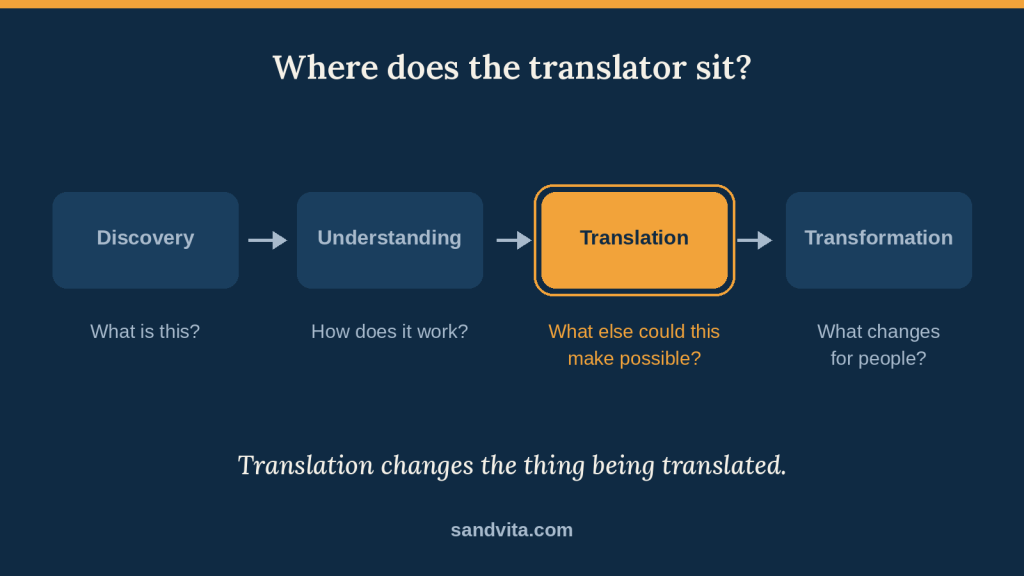
The discoverer asks, “What is this?” The translator asks, “What else could this make possible?” That is a very different cognitive act.
Translation is not transfer
Deisseroth did not simply plug an algal protein into a neuron. The new context created new problems. How do you get the protein into the right cells? How do you target specific cell types? How do you deliver light, and control its timing precisely enough to study circuits?
Translation changes the thing being translated. The translator is not a messenger but a builder of the bridge. It was also not a solo act: Nobel rules stop at three names, but the work involved many more people, including young researchers in Deisseroth’s own lab.
The Ford story: when disassembly informed assembly
Business has its own version of this. In the early 1900s, Chicago meatpacking plants used overhead conveyors to move carcasses past workers, each performing a specialized task. Ford’s engineers drew on this “disassembly line” principle as they experimented with ways to move automobile parts, and eventually chassis, through production.
The result was not a simple copy or the work of one person. It emerged through experiments by a team, combining ideas from meatpacking and other industries with interchangeable parts, specialized tasks and repeated redesign. In effect, a principle used to take something apart helped inform a new way to put cars together. Translation, again, changed the thing being translated.
Organisations need translators too
Every organisation has brilliant ideas trapped inside functional boundaries. A data scientist builds something interesting. A frontline employee invents an ingenious workaround. An engineer develops a capability nobody outside the team understands. A learning team discovers how people actually acquire new skills.
Why do they stay trapped? Because the people who understand what something is are not always the people who can see what it could become.
The translator is the person who says, “Wait. What you’ve just shown us could solve a problem we’ve been struggling with somewhere else.” They may not have invented the technology or be its deepest expert. Their gift is connecting worlds that don’t normally speak to each other.
What this means for leaders
Perhaps we should ask “Who has the best idea?” a little less, and “Who can connect this idea to something that matters?” a little more.
The next breakthrough may not be a new idea at all. It may be an existing idea meeting the right problem. This is especially true now. As AI capabilities become cheaper and more widely available, the scarce skill is no longer building them. It is knowing which problem they were waiting for.
Three questions are worth asking in our organisations:
- Who sits across two functions and speaks both languages?
- Do our incentives reward translators, or only inventors and executors?
- Where can an idea be shown to people who don’t own it?
A final irony
Looking back, the story is wonderfully neat: Hegemann and Nagel discovered this, Deisseroth turned it into that, and eventually came a Nobel Prize. But that chain is a hindsight story, not a plan. Nobody sat in a meeting room with a slide saying, “Our five-year plan is to invent optogenetics.” The people involved were pursuing questions that made sense to them at the time, and the significance of each contribution only became clear once the connections emerged.
That may be the hardest part of leading innovation. You must create enough direction to give people purpose, without pretending you know where the breakthrough will come from. And you must create enough space for ideas to travel.
Because sometimes the most valuable idea in your organisation isn’t waiting for a better idea.
It’s waiting for a translator.

