

In 1999, Pets.com raised millions through an IPO, burned through the money in months, and shut down soon after. It had a sock puppet mascot, a Super Bowl ad, and no viable path to profitability. The internet, of course, survived — and went on to rewire almost every aspect of business and life.
The lesson most people took from that era was simple: separate the hype from the infrastructure.
Back the technology, not necessarily the business model built on top of it. I hear that lesson invoked constantly in AI conversations today. “Remember the dot-com bubble,” people say knowingly. “The weak use cases will disappear. The technology will survive.”
And to be fair, that parallel is real.
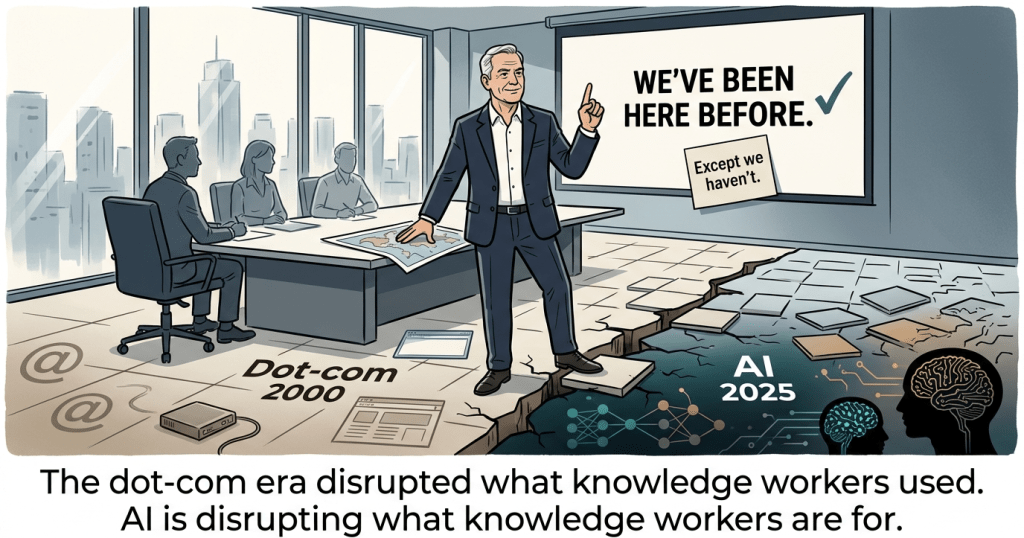
We are living through a familiar phase: massive capital deployment, exaggerated claims, FOMO-driven enterprise adoption, and an almost compulsive use of the word “exponential.” Investor behaviour, start up mortality rates, inflated expectations, and the likelihood of an eventual correction — all of this rhymes loudly with the early 2000s.
But I think we make a mistake when we stop the comparison there. Because beneath the surface similarity lies a far more important difference — one that fundamentally changes the nature of the disruption we are heading toward. The internet changed how work got routed. AI is changing how work gets thought. The internet was primarily an infrastructure revolution. It transformed distribution, connectivity, and communication. It changed how information moved between people, systems, and markets.
Those of us who lived through that transition will remember how it reshaped the edges of knowledge work — how reports got filed, how customers got reached, how transactions got processed.
But the knowledge worker herself remained largely intact. Her judgment, expertise, and professional identity were not fundamentally under threat. AI is different. AI is entering the cognitive core of work — drafting, analysis, synthesis, reasoning, persuasion. It is not merely changing how work moves between people. It is augmenting — and in some cases replacing — the thinking people were hired to do.
That is not an incremental shift. It is a categorical one. “The dot-com era disrupted what knowledge workers used. AI is disrupting what knowledge workers are for.” That distinction matters more than many organisations currently realise.
The scene that should unsettle every CXO
When you ask leaders who have rolled out AI tools across their organization what specific problem they are solving, the answers are often surprisingly vague -“productivity”, “efficiency”. “staying competitive.” These are not really answers. To me they are more like anxieties dressed up as strategy. And this is not about incompetence. It is what happens when technology investment outruns the human question.
In some ways, it resembles the Pets.com pattern all over again — not in scale, but in nature. Capital deployed ahead of clarity. Adoption ahead of purpose.
The dot-com era gave organisations nearly a decade to absorb and adapt to change. Internet adoption unfolded over years. AI capability, by contrast, is evolving in months.
Yes, large enterprises will move slower than the technology itself. They always do. But the gap is narrowing regardless — and faster than most workforce transformation playbooks were designed to handle.
The retraining narrative — and why it worries me this time
Both eras produced the same reassuring response:
“People will retrain.”
“They’ll upskill.”
“They’ll adapt.”
We’ve heard versions of this during the digital transformation years, working with clients navigating internet-era disruption. And it wasn’t wrong. The dot-com wave largely disrupted the periphery of knowledge work. Many displaced skills were task-specific and relatively trainable.
AI is touching something much closer to the centre. When technology can draft reports, structure analysis, generate presentations, and articulate recommendations, the question becomes: Retrain for what, exactly? What is actually at stake this time is not a mere skill set. It is the knowledge worker’s sense of professional identity — the internal answer to the question: “What do I bring that cannot be replicated?”
Retraining can help at the margins. It does not fully answer an existential question.
What workforce transformation actually needs to become
Here is the problem I don’t think we are saying loudly enough: Most HR functions, as currently designed, were not built for this moment. They were built for a world where workforce transformation meant new skills, new roles, new org structures, and finite programmes with timelines and milestones.
AI does not offer that luxury.
This is not a one-time transformation initiative to be managed and completed. It is a continuously evolving condition that organisations will need to navigate in real time as the technology itself keeps changing. What organisations now need is workforce transformation as an ongoing operating capability — not a project.
That means HR leaders who understand AI deeply enough to anticipate role erosion. It means managers capable of having honest conversations with teams about what is changing and why. It means learning architectures that are fluid rather than fixed — focused not only on skills, but on the development of judgment. And it means having someone in the room during AI investment discussions asking a very different question: “What does this do to our people — and are we actually prepared for that?”
In too many organisations today, that voice still isn’t in the room. And that gap is widening faster than many boards realise.
Informed optimism — but earned, not assumed
I remain optimistic about human adaptability. History repeatedly shows that we underestimate it.
The knowledge workers who will thrive in the AI era are unlikely to be those who simply “use AI tools.” They will be the people who develop fluency in directing judgment — understanding where human discernment matters most, and where technology can operate independently. But that future is not automatic.
It requires leaders who recognise that AI adoption is not merely a software rollout. It is a human transition. Before the next AI investment decision, I would ask one question: What does work look like after AI — and have we prepared anyone for that reality?
The dot-com comparison is useful up to a point. Just as the internet survived the crash, foundational AI technologies will survive whatever correction eventually comes. But the conversation waiting for us on the other side will not primarily be about infrastructure. It will be about identity, meaning, judgment, and what we ultimately value in human work.
Unlike the dot-com era, there is no historical playbook for that. Which means the leaders shaping this transition are writing one in real time.
The question is whether you want to be among them.

