

On luck, surface area, and the art of staying open
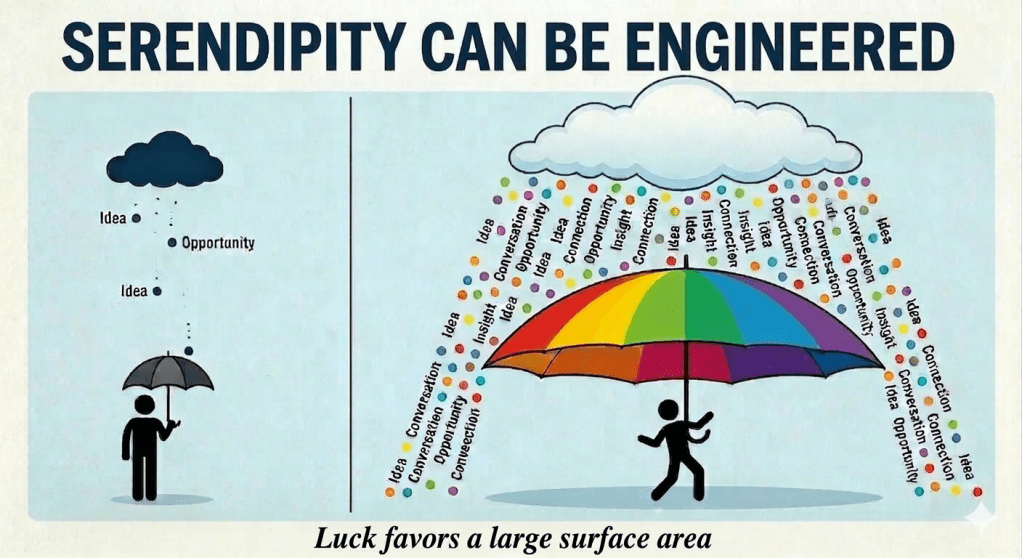
Most people think serendipity is luck. A happy accident. Something that visits the fortunate few while the rest of us wait, hoping it will one day find us too.
I’ve come to believe that this is one of the most limiting ideas we carry around. Serendipity isn’t something that happens to you. It is something you make room for. And the size of that room is almost entirely within your control.
Serendipity is not random. It is not fully deterministic either. But the probability is very much in your control
The Espresso Bar in Milan
In 1983, Howard Schultz was a young marketing director at a small Seattle coffee company called Starbucks. The company sold coffee beans. It did not sell coffee drinks. Schultz was in Milan on a buying trip when he wandered into an espresso bar — not with a purpose, but with curiosity.
What he encountered was not just a cup of coffee. It was a ritual. A community. A third place between home and work where people gathered with no particular agenda. Schultz stood there, watching, and something clicked. He wasn’t looking for an idea. But he was curious. He was present. He was paying attention. The surface area was large.
The rest, of course, is history. Schultz started his own company before eventually acquiring Starbucks and transforming it. The serendipitous moment in Milan was only the seed. What made it grow was everything Schultz did to remain available to that kind of discovery — traveling, observing, staying open to what a foreign culture might teach a coffee company back home.
The Adhesive That Wouldn’t Stick — And Changed Everything
Spencer Silver was a chemist at 3M. In 1968, he accidentally created an adhesive that was the opposite of what a good adhesive should be: it was weak, it peeled off cleanly, and it left no residue. By the standard of what Silver was trying to make, it was a failure.
What Silver did next is the interesting part. He didn’t throw the formula away. He didn’t quite know what it was for, but something told him it mattered. For years, he gave seminars talking about this strange adhesive with no obvious application. He kept putting the idea into the world — not because he knew where it would land, but because he believed it deserved to. Years later, a colleague who heard him invented the Post-it Note. It was born not from a single moment of inspiration, but from Silver’s stubborn commitment to keeping a half-formed idea alive and in circulation.
This is what engineered serendipity often looks like: not a lightning bolt, but a long, patient process of putting something out into the world and trusting that the right person or moment will eventually find it.
The Evening I Almost Didn’t Go
I should tell you something about myself. I am a devoted listener of Hindustani classical music — specifically the Khayal tradition, with its intricate improvisation, its ornate taans etc. I have spent decades in its company. I thought I knew what I loved.
I was also, for a long time, quietly prejudiced against Dhrupad — the older, more austere cousin of Khayal. Where Khayal felt alive and expressive to me, Dhrupad seemed severe, almost forbidding. Slow. Unornamented. It did not speak to me, or so I told myself.
One evening, there was a Dhrupad recital at my music school. My guru — knowing my bias well — made a quiet suggestion. “Don’t decide in advance,” he said. “Go. Sit for twenty minutes with your eyes closed. After that, if it still doesn’t reach you, leave”. I fought with myself. Twenty minutes is a reasonable ask, I knew. But I also knew I was really fighting something harder — the comfort of a settled opinion, the smugness of someone who thinks they already know what they like.
I went. I closed my eyes. And somewhere in those twenty minutes — in the deep, unhurried unfolding of the elaborate alap, — something in me went still. The music wasn’t trying to impress me. It was simply being. And slowly, slowly, I began to hear what I had been blocking out for years.
I didn’t leave after twenty minutes. I stayed for the entire recital. Today, if you asked me which tradition I love more, I would say Dhrupad — with the slightly embarrassed joy of someone who nearly walked past a treasure.
My biggest obstacle to serendipity that evening wasn’t circumstance. It was the resistance inside me.
I tell this story not because music is your domain, but because the pattern is universal. How many ideas have we dismissed before we really heard them? How many conversations have we half-attended because we’d already decided the person had nothing to teach us? How many rooms have we declined to enter because we were certain, in advance, that we didn’t belong?
Taleb and the Logic of Positive Optionality
Nassim Taleb, in Antifragile, articulates something that I’ve found quietly liberating. He observes that there is a class of actions which are worth taking not because you can define their benefit in advance, but simply because they increase your exposure to positive optionality — the chance of an upside you cannot currently name.
This is not the same as being reckless. The cost of attending a lecture outside your field is an evening. The upside could be a decade-defining connection. The cost of sharing an unfinished idea is mild embarrassment. The upside could be a collaboration that changes the trajectory of your work.
What Taleb calls positive optionality, I have come to think of more simply as increasing your luck surface area. The larger the surface you expose to the world — through curiosity, conversation, presence, and a willingness to be surprised — the more likely that something good will land on it.
I have watched this play out more times than I can count — in businesses that found their breakthrough pivot not in a strategy session but in an offhand remark at a conference; in careers that turned on a conversation that had no obvious agenda.
How to Increase Your Luck Surface Area
Show up in rooms you don’t fully belong to yet. The most interesting things happen at the edges of your expertise, not at the centre. The colleague from a different function, the conference outside your industry, the dinner where you’re the least qualified person at the table — these are not distractions. They are precisely where the unexpected finds you.
Share half-formed ideas before they’re polished. Finished ideas don’t need other people. It’s the rough, incomplete thought — the thing you’re still working out — that invites collaboration, provokes reactions, and attracts others who have been thinking about the same problem albeit from a different angle. Spencer Silver didn’t wait until he had a product. He shared the anomaly and let the world complete it.
Say yes to conversations that have no obvious agenda. The calendar full of purposeful meetings is efficient but also sterile. The conversation that begins with no agenda — a walk, a coffee, a chat that runs over its allotted time — is where the genuinely surprising things tend to happen. Whoever said the “think time” in your calendars should be spent in solitude?
Follow curiosity even when you can’t justify it on a spreadsheet. Steve Jobs famously dropped into a calligraphy class after dropping out, with no practical purpose in mind then. That single detour shaped the typography of every Apple product ever made.
Examine your prejudices — and occasionally, deliberately override them. I would never have found Dhrupad if I had trusted my prior opinion absolutely. Some of the most valuable experiences of my life have come from agreeing to sit through twenty minutes of something I was sure I wouldn’t like. Your settled preferences are not infallible.
Be an Explorer, Not a Passenger
Serendipity is not random. The word itself comes from a Persian fairy tale about three princes from Serendip — modern-day Sri Lanka — who were always making discoveries they were not looking for. But look closely at the tale: the princes were not passive. They were observant, curious, and engaged with the world around them. Their discoveries were not accidents. They were the fruit of a particular way of moving through life.
That way of moving is available to all of us. It doesn’t require extraordinary luck. It requires showing up fully — with curiosity intact, defences lowered, and enough humility to accept that the world contains things we haven’t imagined yet.
Luck favours a large surface area. Stop waiting for serendipity. Start engineering it.
The espresso bar is out there. The adhesive with no application is waiting for someone to talk about it long enough. The music you’ve been avoiding might be the music that changes you.
Go. Stay curious. Increase the surface area.
Be an explorer.
— ◆ —
Further reading: The Serendipity Mindset by Christian Busch · Antifragile by Nassim Nicholas Taleb · The Luck Factor by Richard Wiseman · Where Good Ideas Come From by Steven Johnson
 sandvita.com