

Have you ever promoted a “star” performer who consistently hit the numbers—only to discover, a year later, that the culture had weakened and the strategy had drifted. Or, for that matter watched a sales team smash quarterly targets on legacy products while your supposedly strategic new offering struggled for oxygen?
I spent a year maxing out the metric my organization said mattered. At review time, a completely different metric got rewarded. It took me a while to realize this wasn’t bad luck or a biased manager — it was a design flaw baked into how most organizations operate.
Most of us have been on one side of this. Many have been on both.
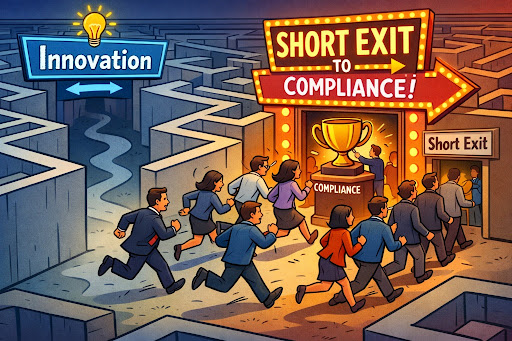
This paradox was articulated powerfully by Steven Kerr in his classic 1975 essay, “On the Folly of Rewarding A, While Hoping for B.” His premise was deceptively simple: Organizations routinely reward behaviors they do not actually desire — and then act surprised when people deliver exactly what they were incentivized to deliver.
Nearly fifty years later, the problem has not disappeared. If anything, in a world of dashboards, KPIs, and algorithmic performance tracking, it has become more institutionaliz.
The Everyday Version of the Folly
This isn’t a theoretical misalignment. It plays out in boardrooms, operating committees, and classrooms every day.
| Context | Rewarded (A) | Hoped For (B) | Typical Outcome |
| Sales | Quarterly quota | Customer lifetime value | Discounting, churn |
| Business Units | Revenue growth | Margin expansion | Profit erosion |
| Corporate Leadership | No visible failures | Innovation | Risk aversion |
| Academia | Publications, grades | Deep learning | Compliance over curiosity |
| Healthcare | Throughput | Diagnostic accuracy | Overtesting or errors |
| Military | Documentation | Initiative | Bureaucratic paralysis |
None of these organizations are foolish. Most are led by intelligent, experienced professionals. Yet the system produces outcomes no one explicitly wants. Why?
Why Intelligent Leaders Fall Into This Trap
1. We measure what is easy, not what matters.
Customer loyalty is complex. Quarterly revenue is simple.
Judgment is nuanced. Compliance is countable.
Innovation is uncertain. Output is trackable.
Dashboards reward clarity. Reality rarely offers it.
2. We say “long term” but pay for “short term.”
Bonuses are annual. Markets are quarterly. Promotions are immediate. When the incentive cycle is short, behavior becomes short-term—regardless of long-term rhetoric.
3. We underestimate how rational people are.
People are extraordinarily good at optimizing for the system they are placed in.
If you reward output volume, you will get output volume.
If you reward visible heroics, you will get performative heroics.
If you reward risk avoidance, you will get silence. The issue is rarely motivation. It is design.
The Learning Paradox
Consider education.
Institutions claim they want critical thinkers, independent judgment, and intellectual curiosity. Yet grades reward precision within rubrics. Standardized evaluation favors structured replication over original exploration.
Students are smart – they quickly understand the rules. They optimize for grades—not learning.
Can we blame them? Didn’t we design the game?
The same dynamic operates in corporations. Employees optimize for ratings, bonus pools, and promotion criteria—not for mission statements.
The Hidden Organizational Costs
The consequences are deeper than missed targets. Cultural erosion sets in when informal signals contradict formal values and trust declines. Talent becomes distorted as risk-takers leave and political optimizers rise. Strategic drift follows as short-term incentives cannibalize long-term positioning. And ethical slippage creeps in when pressure to “hit the number” reshapes decision-making boundaries.
Many corporate scandals did not begin with malicious intent. They began with poorly aligned incentives.
The Hard Work of Alignment
Fixing this is conceptually simple—and operationally uncomfortable.
1. Be honest about what you truly want.
If you cannot tolerate intelligent failure, you do not want innovation.
If you cannot endure margin pressure, you do not want premium positioning.
If you cannot accept dissent, you do not want independent thinking.
Clarity precedes alignment.
2. Audit promotions, not policies.
Mission statements rarely reveal true priorities. Promotions do. Ask :
- Who rose fastest last year?
- What behaviors were praised publicly?
- What mistakes were punished disproportionately?
- Where did discretionary budgets actually flow?
Incentives reveal strategy more honestly than any strategy deck.
3. Reward leading indicators.
Customer retention, experimentation velocity, cross-functional collaboration, capability building—these are harder to measure but often more predictive of long-term value than quarterly revenue spikes. Qualitative judgment must supplement quantitative metrics. Not everything valuable fits neatly into a spreadsheet.
4. Protect long-term bets structurally.
Innovation cannot survive under quarterly scrutiny alone.
Ring-fenced budgets, staged milestones, and board-level patience are design choices—not philosophical preferences.
A Practical Reflection Exercise
If you lead a team or business unit, take ten minutes:
- Review the last five promotions.
- Review the last three performance reviews you conducted.
- Review the last budget allocation decision.
Then ask: What behavior did this decision actually reward? If that answer differs from your stated priorities, you have found your “A vs B” gap.
Why It Still Matters
Kerr’s 1975 paper feels timeless in 2026. Tech evolves fast; incentives lag. The paradox is human:
- We chase certainty over ambiguity.
- Measurable over meaningful.
- Short-term wins over resilience.
Surviving organizations fix this deliberately—like product design.
Uncomfortable Question
What are you rewarding today that kills tomorrow’s goals?
Aspiration-incentive gaps aren’t philosophical—they’re expensive. Want different outcomes? Reward different behaviours. Simple as that.
 sandvita.com