

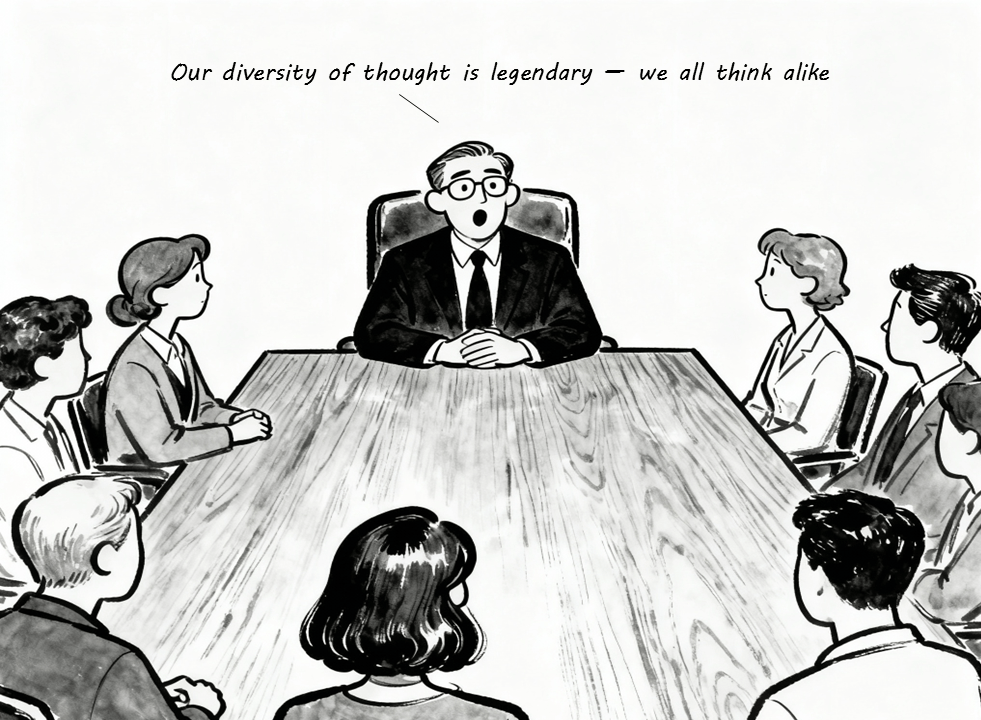
Picture this meeting. The CEO outlines a bold vision for the next quarter—heavy investment in a new AI-powered platform. The idea sounds futuristic but risky. A few managers shift uncomfortably, but no one speaks up.
One director jumps in: “That’s a fantastic idea, we’re fully aligned.” Everyone else quickly echoes agreement.
The meeting ends in 30 minutes with unanimous support. But later, during coffee breaks, you overhear:
“This could stretch us too thin.”
“Our current customers aren’t even asking for this.”
So what just happened?
Was there genuine debate—or just echoing the leader’s opinion?
This is sunflower bias in action—when teams instinctively “turn toward the sun,” i.e., the person in power.
What Is Sunflower Bias? (Leadership Bias Explained)
The term comes from how sunflowers naturally turn toward the sun. In organizations, it describes how team members orient their opinions and decisions toward the most powerful person in the room—usually the leader.
It leads to conformity, groupthink, and the suppression of diverse opinions. And it’s rarely intentional. People may:
- Fear damaging their relationship with the leader.
- Believe that alignment will be rewarded.
- Assume the leader has more information.
- Simply want to avoid conflict.
It can feel like harmony, but it’s often just silent agreement—and silence rarely leads to sound decision-making. The real cost? Missed risks, lost innovation, and unseen blind spots.
Corporate Lessons from Leadership Bias
History offers plenty of cautionary examples:
- Nokia: Once the global mobile giant, managers later revealed they rarely challenged leadership. Confidence at the top silenced debate. By the time honest conversations began, Apple and Samsung had already taken over.
- Volkswagen Emissions Scandal: Analysts found that fear-driven compliance and blind alignment with leadership goals pushed employees to cut corners instead of speaking up about unrealistic targets.
Research reinforces this. A Harvard Business Review study (2017) found that meetings led by dominant leaders produced 42% fewer alternative ideas. And Gallup reports only 30% of employees strongly agree that their opinions matter at work.
The takeaway: alignment brings efficiency, but unquestioned alignment brings fragility.
Why Sunflower Bias Happens (Psychological Safety Breakdown)
At its root, sunflower bias stems from a lack of psychological safety—the belief that your workplace is safe for honest conversations and interpersonal risk-taking.
A few key behavioral science principles are at play:
- Authority Bias: We overvalue a leader’s opinion.
- Social Proof: If everyone is nodding, we do too.
- Loss Aversion: The fear of losing face or favor outweighs the gain of speaking truth.
- Career Incentives: “Alignment equals growth” is a silent organizational currency.
When people fear ridicule or reputational harm, conformity feels safer than candour. Left unchecked, these drivers create echo chambers that filter out uncomfortable truth.
The Real Impact on Leadership and Teams
Many leaders mistake agreement for engagement—but that’s not the same thing. Sunflower bias creates an illusion of consensus while concealing unspoken doubts and risks.
Here’s how it hurts your organization:
- Strategic Missteps: When assumptions go unquestioned, poor decisions follow. McKinsey finds teams that debate deeply make 20% better decisions.
- Innovation Blockages: Breakthrough ideas often come from disagreement. A “yes culture” turns creativity cold.
- Employee Disengagement: When people feel unheard, retention crumbles. Gallup estimates firms lose $1 trillion annually in voluntary turnover from employees feeling voiceless.
- Reputation Risk: Ethical lapses and compliance violations often go unnoticed when opposing views are suppressed.
How to Spot the Signs of Groupthink in Teams
Leaders can start by reflecting honestly:
- Do meetings end too quickly, with no real debate?
- Are the same few people always the dissenting voices?
- Do team members share concerns privately after meetings—but not during them?
- Is silence automatically treated as agreement?
If several of these sound familiar, sunflower bias might already be shadowing your team.
How to Fix Sunflower Bias (Practical Leadership Tips)
Here’s how to break the pattern and nurture real psychological safety at work:
1. Don’t Speak First
Leaders often unknowingly set the tone. If you open with your view, the group orients toward it. Instead, ask open-ended questions first, listen, then summarize.
2. Assign a Devil’s Advocate
Rotate the role of someone whose job is to challenge the dominant view. Research shows that when “constructive dissent” is encouraged, teams generate more diverse and higher-quality ideas.
3. Use Anonymous Input
Tools like digital polls or sticky notes in workshops let people contribute without fear of judgment.
4. Reward Dissent, Don’t Punish It
When someone raises a contrarian point, thank them—even if you don’t agree. Over time, this normalizes speaking up.
5. Break the Hierarchy Temporarily
In brainstorming, ask junior members to present first. This prevents senior voices from setting the direction prematurely.
6. Explicitly Invite Challenge
End discussions by asking: “What risks are we not seeing?” or “If this fails, what will have been the reason?”
7. Model It Yourself
Leaders who admit mistakes or openly change their mind send a powerful signal that dissent is safe.
Conclusion: Real Leadership Means Hearing Every Voice
Sunflower bias is a quiet but powerful force that can weaken even high-performing teams. Leaders who want innovation and agility must go beyond chasing alignment—they must create cultures of confidence where people speak the truth, not just what’s safe.
In today’s world of disruption and uncertainty, organizations don’t need more agreement; they need more authentic voices.
So, the next time you’re in a meeting and everyone’s nodding in unison, pause and ask:
Are they truly aligned—or are they just facing the sun?
 sandvita.com