

AI is like strapping a race car engine into the heart of a business. It can take you from zero to one hundred faster than anything we’ve seen before. But here’s the catch: without seatbelts and steering, that same speed doesn’t just win races — it causes crashes.
That’s exactly the board’s dilemma today. The pressure is to accelerate, to seize the AI opportunity now. But speed without wisdom is dangerous. Boards must ensure that this engine of transformation drives growth safely, sustainably, and competitively.
The urgency: Why boards can’t sit this one out
AI is not a shiny new object, nor is it just about efficiency. It’s already rewriting business models and competitive dynamics. First movers gain compounding advantages: they capture data, train better models, and build moats around their business.
But there’s a warning signal flashing too: scaling recklessly invites regulatory scrutiny, ethical blowback, and cultural distrust within the workforce. The real winners will be those who combine urgency with foresight — moving fast, and moving wisely.
The trap: Fast but fragile
Recognize this pattern?
* Management races to deploy AI everywhere — automating processes, launching chatbots, plugging in new tools across departments.
* In the frenzy, critical steps get skipped — governance, compliance, employee readiness.
* The outcome? Reputation hits, wasted investments, initiatives that stall out.
* The restart is slow and cautious.
That’s where the board steps in — not to run the AI program, but to keep the enterprise on track and out of the ditch.
The board’s job: Keep speed, demand wisdom
Boards obviously don’t have to run AI programs, but they need to ensure management is running them responsibly, and that AI adoption creates lasting advantage rather than flashy but fragile wins. That oversight comes down to three dimensions:
- Governance and Risk (“G” and the “R” in GRC)
- Is there a clear AI governance framework aligned with enterprise risk management? Is the AI strategy aligned with the business strategy? (Combined for clarity)
- Are legal, compliance, and the Chief Risk Officer actually in the room when AI strategy is set?
- Who, ultimately, is accountable for AI mistakes?
- Responsible & Compliant (“C” in GRC)
- Are there guardrails to stop bias, hallucinations, or data misuse?
- How are we tracking fast-evolving regulations across different countries?
- Have we set clear red lines — things employees must never use public GenAI tools for?
- People and Culture
- Is there a clear narrative on the centaur employee model (AI-augmented humans) — emphasizing augmentation over displacement?
- Do we have a reskilling and change management strategy that will drive this centaur model?
- Are senior leaders modelling smart AI use themselves? Walking the talk – Board members should actively use smart AI themselves.
A practical toolkit for boards
Board discussions don’t need to be vague. Anchoring around four guiding questions can cut through the fog:
- Strategy – Where does AI fit into our long-term business and operating model? What use cases matter most?
- Governance – What oversight structures ensure adoption stays aligned with ethics, regulation, and our risk appetite?
- Talent – How are we preparing employees for the centaur model, and what’s our plan for managing displacement concerns?
- Measurement – Beyond pilots and press releases, how will we measure business value from AI?
Big picture: Scale first, scale wisely
Here’s a simple way to visualize it — a two-by-two matrix:
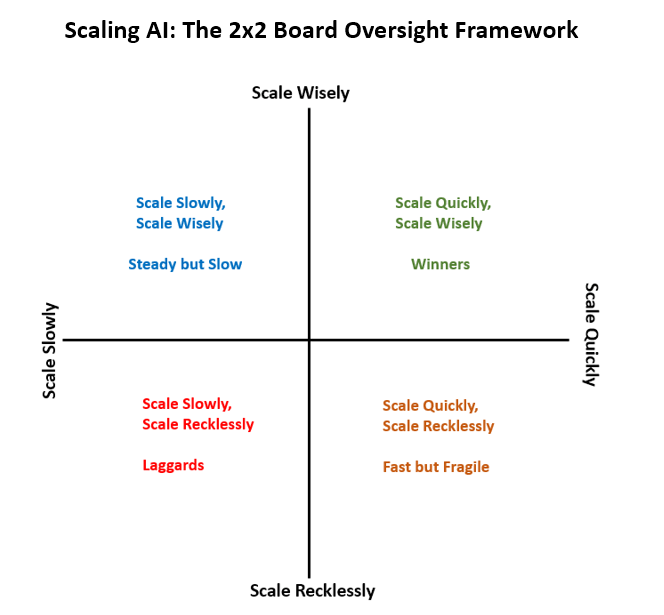
- Scale fast + scale wisely → The winners. They turn early adoption into durable advantage.
- Scale fast + scale recklessly → Flashy at first, fragile in the long run.
- Scale slowly + scale wisely → Low risk, but opportunity passes them by.
- Scale slowly + scale recklessly → No value, high risk. The true laggards.
The board’s north star? Push the company towards that elusive top-right quadrant: fast and wise.
The call to action
Your role isn’t to pull the handbrake. Your role is to ensure the accelerator and the brakes work together.
Boards that press management to scale AI both first and wisely — pairing foresight with urgency, risk management with opportunity capture, and technology with people — will do more than protect their companies.
They’ll help them lead in the AI economy. And in this new era, leadership isn’t optional.
 sandvita.com