

Picture this.
An insurance company asks three of its best underwriters to evaluate the same client application. One says the premium should be $95,000, another says $150,000, and the third? $210,000. Same file. Same company rules. Same data. Three wildly different answers.
What’s going on here? Are these people incompetent? Nope. This is what Nobel Prize winner Daniel Kahneman calls noise.
And here’s the kicker: while most companies spend a ton of time fighting bias in decisions, very few ever stop to measure noise. Yet research shows it could be responsible for nearly half of all judgment errors in business.
Bias vs. Noise: The Big Picture
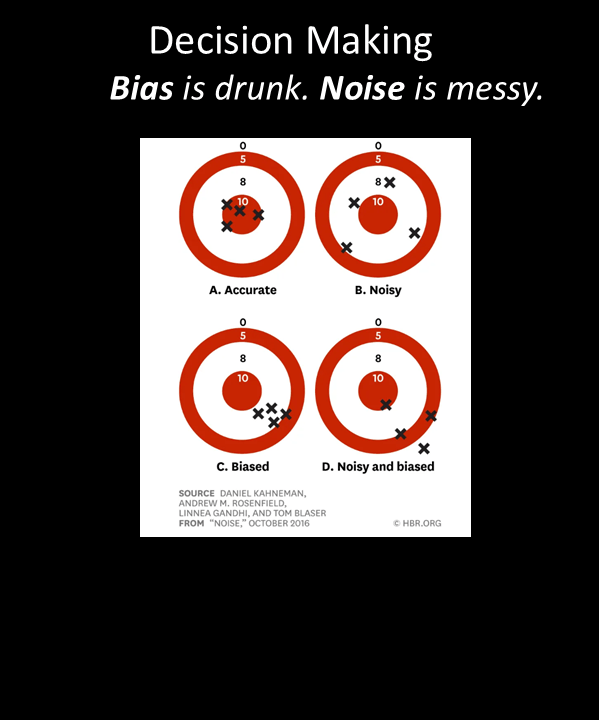
We’ve all heard of bias. There are entire training programs dedicated to unconscious bias, cognitive bias, hiring bias—you name it. And rightly so. Bias is when decisions are consistently tilted in one direction.
But noise? That’s the messy, random scatter that makes decisions inconsistent and unreliable. Kahneman, in his book Noise: A Flaw in Human Judgment, argues that both bias and noise ruin decision quality, just in different ways.
Let’s make this crystal clear:
- Bias = a hiring manager always prefers candidates from their alma mater.
- Noise = two equally qualified candidates get very different interview scores just because one was seen on Monday morning and the other on Friday afternoon.
So while bias is being predictably wrong, noise is being unpredictably all over the place.
Key Differences between Bias and Noise in decision making
| Aspect | Bias (Systematic Error) | Noise (Random Scatter) |
| Pattern | Consistently off in the same direction | All over the map |
| Spotting It | Easier to detect in averages | Much harder—you need “noise audits” |
| Impact | Predictable but wrong decisions | Unreliable and inconsistent decisions |
The Three Flavours of Noise
Noise doesn’t just come in one form. Researchers have found three main types:
- Level Noise
Some decision-makers just operate on different baselines. One loan officer is always stricter, another is always more lenient. Same rules, different thresholds. - Pattern Noise
Different people weigh the same factors differently. One recruiter loves leadership experience. Another cares more about technical skills. Same résumé, different scorecards. - Occasion Noise
The same person changes their decision depending on the day, the mood, or the context. On Monday morning, a manager reads a report generously. On Friday afternoon, stressed and tired, the exact same report feels below par.
An analogy will help make this clear.
A Cookie Analogy (Because Who Doesn’t Love Cookies?)
Think of three home cooks A, B and C making the exact same cookie recipe.
- Level Noise: Cook A has a sweet tooth and always adds extra sugar, Cook B follows the recipe exactly, Cook C cuts the sugar down. Same recipe, different baselines.
- Pattern Noise: When the recipe calls for adding vanilla extract, Cook A pours in extra, Cook B sticks to the teaspoon, Cook C skips it because of a bad past experience. Same instructions, different reactions.
- Occasion Noise: Cook B, the “rule follower,” makes cookies differently depending on the day. Careful and precise on Monday. Sloppy and tired on Friday. Cozy and creative on a rainy Saturday (with a pinch of cinnamon).
The recipe didn’t change. The cooks did. That’s noise. And corporate decisions work the same way. The “ingredients” (data, policies, criteria) are the same, but human variability sneaks in and scrambles the outcome.
Everyday Sources of Noise
Noise often hides in plain sight. Consider these:
- Weather: Admissions officers weigh academics differently depending on whether it’s sunny or cloudy.
- Time of Day: Doctors prescribe opioids more often at the end of their shifts.
- Sequence: Judges are more likely to deny an asylum case if they’ve just approved several in a row.
- Order Effects: The sequence of information matters—even when the facts don’t change.
Unsettling, right? But it’s reality.
Decision Hygiene: Washing the Noise Out
Kahneman suggests something called decision hygiene. Just like washing your hands doesn’t guarantee you won’t catch a cold but makes it much less likely, decision hygiene reduces judgment errors.
Here’s what it looks like:
- Noise Audits – Get multiple people to review the same case independently, then compare. You’ll be shocked at the spread.
- Structured Processes – Use rubrics, checklists, and standardized scoring. It’s not about killing creativity—it’s about making decisions more consistent. AI can be used in the first stage to get rid of the noise. And human involvement in the next stage will reduce bias (AI systems can be heavily biased thanks to their training data.)
- Independent Opinions – Collect judgments before people talk as a group. Groupthink muddies the waters fast.
- Delayed Integration – Assess different parts of a case separately before rolling it into a final decision.
- Blind Reviews – Strip out irrelevant details like names, photos, or alma maters to cut both bias and noise.
Why Leaders Should Care
Here’s the thing about noise: it hides. Bias shows up in patterns. Noise just looks like “normal variation.” Until you measure it, you won’t know how bad it is.
But the cost is very real:
- In insurance, underwriter inconsistency = millions lost in pricing errors.
- In consulting, project estimates swing wildly depending on who leads the pitch.
- In HR, hiring decisions may feel like a lottery when they should be systematic.
Noise isn’t just a technical glitch—it’s a business risk. It undermines fairness, damages trust, and drains profit.
The Bottom Line
Every organization has noise. Probably a lot more than we think. The real question is: Are you willing to measure it—and do something about it—before it causes more harm?
Bias reduction got all the attention in the last decade. The next frontier of smarter decision-making?
Tackling noise head-on.
 sandvita.com