

“Is AI going to take our jobs?”
It’s the question everyone’s asking—whether you’re in a boardroom, a classroom, or just chatting with friends. And honestly, it’s a valid worry. AI and automation are moving fast, faster than anything we’ve seen before. So yeah, feeling a bit uneasy about what the future holds is natural.
But here’s the thing: history shows us that technology doesn’t usually kick humans out of the picture. Instead, it changes our roles. The folks who win will be the ones who don’t try to go head-to-head with machines but team up with them instead.
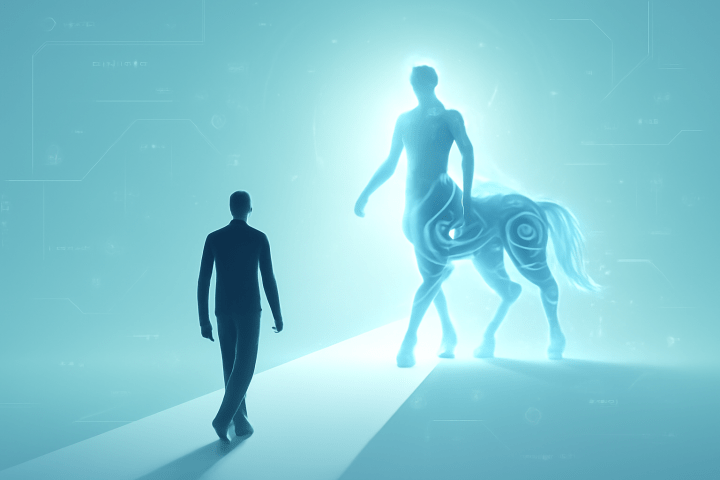
I like to call this the Centaur Employee idea—like the half-human, half-horse creature from mythology. Today’s version is half-human, half-machine: people who use AI’s speed and power but add the creativity, empathy, and good judgment that only humans have.
When AI Works on Its Own
Let’s be real—there are times when AI running solo makes sense:
- For simple, repetitive stuff like processing transactions or managing logistics, AI is lightning fast and never gets tired.
- In areas where precision beats judgment, like managing inventory or doing high-frequency trading, AI can even beat humans.
These things matter a lot and we shouldn’t ignore them. But—and this is a big but—they don’t cover everything.
Where Humans Need to Stay in Charge
When it comes to tricky stuff—ethics, trust, creativity—AI just can’t handle it on its own. Here’s why:
- AI doesn’t “get” ethics; it mainly focuses on being accurate, not on what’s right or wrong.
- It can’t really read the room or understand feelings and cultural context.
- And people want to know a real human is responsible, especially when stakes are high.
That’s where the Centaur model really shines. And there’s data to back it up.
Proof That Humans + AI Are Better Together
- Medical diagnosis: Studies with tens of thousands of cases show humans and AI together outperform either one alone.
- Breast cancer screening (Sweden): AI combined with radiologists caught 20% more cancers, cut false alarms, and nearly halved doctors’ workload—tested on over 80,000 women!
- Knowledge work (BCG study): Consultants who used GPT-4 did 20–47% better work. But when they blindly trusted AI, accuracy dropped—showing you’ve got to be smart about how you use it.
The pattern’s clear: humans plus AI = better results. Humans without AI or blindly trusting AI? Risky business.
How to Be a Centaur (and Win in the Future)
Think of it like boats in a harbor when a storm’s coming. Some boats are strong; some are pretty leaky. At first, people think, “If my boat’s just better than the weakest, I’ll survive.” But soon, it’s clear: it’s about how strong your boat really is.
That’s where we are. The AI wave is coming fast. Just being a bit better than average won’t cut it anymore. You’ve got to be prepared, adaptable, ready to ride out the storm.
In addition to the technical/ domain expertise here are four skills every Centaur needs:
- Critical Thinking: Know when to trust AI and when to double-check it. Don’t take things at face value.
- Communication & Empathy: AI can handle data but humans are still the ones who build real connections and trust.
- Creativity & Problem Framing: AI solves problems, but it’s humans who ask the right questions and come up with new ideas.
- Always Learning: Tools will keep changing. Staying curious and flexible is your best shot at long-term success.
What It Means Going Forward
AI will keep getting faster and smarter. In some areas, it’ll take over. But whenever things involve ethics, values, or trust, humans working with AI will always have the edge.
It’s not man vs. machine anymore. It’s man with machine.
If you figure out how to be a Centaur, you won’t just survive the AI era—you’ll shape it, lead it, and make a difference.
So don’t ask if Centaur Employees are coming. Ask yourself: Are you building them in your teams right now?
 sandvita.com
One thought on “Centaur Employees: Why Humans and AI Are Better Together”